Because of some innate advantages jet engines have over piston engines the core of aviation started shifting over to pure jet powered aircraft in the late 40's. Jet engines weren't as limited by atmospheric conditions or by rpm as piston engines were, they could also be made smaller, more powerful, and more efficient compared to the previous era of propulsion. But the full switchover was slow, lots of different technologies were all emerging at the same time and no one company had the definitive right answer for, "What does a jet fighter actually look like?" Among the many attempts to modernize fighters was the idea of mixed propulsion. Mixed propulsion on an aircraft is a two engine set up, one piston engine in the front and one jet engine in the back. There are several examples of this in history but for the sake of this study there's only one in game, so far. The Ryan FR-1 Fireball was an early attempt at modernizing naval fighters. The convention at the time was that jet propulsion was unsuitable for carrier use as jet engines weren't responsive enough to handle carrier landings. Piston engines were an understood technology, with a piston engine you could rapidly raise and lower throttle position with little consequence. As opposed to a jet engine which could take as long as thirty seconds to respond to your throttle input. So to get around this hurdle the idea was to stick a radial engine to the aircraft, that way the radial could handle the rapid changes in thrust instead of the jet, while also maintaining the better cruising speeds and performance of a jet since the aircraft now had both engines.
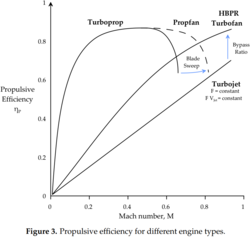
One of the earliest attempts to modernize convetional fighters was the turbo-prop. Engineers were chasing efficiency and low cost; they asked themselves, "What if instead of a jet turbine throwing all of its thrust out the back we instead captured it with a new section of rotors aft of the combustion chamber?" Or something to that effect, the turbo-prop was born. On a turbo prop instead of wasting all of the exhaust gases as jet propulsion only, the thrust is forced through a series of rotors and stators, a similar section used to compress the air in the first place, thus capturing all of the escaping gas as rotational energy. Of course some of the exhaust must escape anyways and this can also be used as thrust.
In war thunder there are 3 turbo prop aircraft, the A2D, the Wyvern S.4, and the Qing-6. All of these aircraft (and the aforementioned FR-1) are barred from standard air racing as they all feature a jet engine in some way.
A2D-1 Skyshark
AEC:
The A2D is (by technicality) the fastest prop in the game, capable of maintaining 450 mph on the deck in level flight. The Skyshark lives in the 370-420 mph range and under 400 mph accelerates like a beast. Unlike other aircraft which can get back to their top speed in the final stretch, post final bridge, the A2D actually never stops accelerating. In typical testing fashion I went from the standard take off point to the starting line and recorded a max speed of 450 mph, but in truth the A2D could continue to accelerate if it just had more room. Because of the nature of using turbine engines over piston engines, the A2D overheats very slowly; it's more than capable of staying at 100% throttle for the duration of the race. On that note, it does not get WEP. Lastly the Skyshark maneuvers around essentially the same as the AD-2 or 4, that is to say it's one of the most elegant semi trucks I've ever flown. It has decent energy retention, perhaps the best acceleration and the best top speed, the A2D is why turbo-props are a separate category and away from the main list.
MEC:
The A2D has no MEC options, not even propeller pitch, which is another reason it's barred from standard air racing and also why it's not on the MEC list.
FR-1 Fireball
AEC:
The FR-1 dives into the race at about 370 mph but lives in the 310-340 range. The biggest problem with this aircraft isn't the weight of hauling two engines around, but rather the airframe is prone to losing speed even in the most minor course corrections. Surprisingly the jet engine overheats first, requiring throttle to be pulled back, and because this is in AEC, throttle is pulled back on both engines simultaneously; so the radial never has a chance to overheat itself. The only problem with this AEC algorithm is the exhaust duct for the radial is this large single flap on the right side of the fuselage. Side note the FR-1 can fly on just its jet engine alone but not just on its radial engine alone. When it's racing on just its jet engine all of the energy problems it has don't exactly disappear, they just become less noticeable as the aircraft is now moving so slowly for it to matter.
MEC:
The FR-1 is the first plane in this study to require not only MEC but different MEC on each engine. This will come up again when I test other aircraft that have a tandem engine layout. I set the jet engine to 103% which is just shy of max throttle and enough to keep the engine from overheating over the course of the race. The radial is set to 95% 0-10%, of course raising the rads after the first overheat. One last interesting thing about the Fireball is that it has mix% on both the radial and the jet engine. Now mix% doesn't affect racing performance at this low alt so there's nothing to gain here from messing with it. However jet engines typically can't make use of any MEC options as the importance of consistent performance of the jet engine far outweighs the need to change engine parameters with something like MEC. That being said, some jets in this game do have MEC options and it's just a visual UI bug everytime, the fireball is no different. Mix% at altitude doesn't affect the performance of the FR-1 either and I don't believe changing it does anything to the engine anyways.
Wyvern S.4
AEC:
The simplest way to sum up the Wyverns performance is, "Responsive but not fast." Or in other words it starts pulling angle of attack very quickly, and it looks like it's really pulling a lot, but in reality it's hardly moving at all. Its energy retention, especially around hairpins, is egregious. Easily dumping 50-75 mph or more of its current speed just to make the corner. Wyvern is a little laterally drifty and struggles to follow a straight line or make minor course corrections. The only thing going for this plane is its acceleration thanks to its turbo prop, it accelerates like an early jet. The Wyvern dives in at 400 mph, among the fastest aircraft in the race, but lives in the 300-350 range because of its energy retention problems.
MEC:
The Wyvern has access to prop pitch% but it doesn't change the performance of the aircraft.
This is by no means a comprehensive list but here are some other turbo prop/mixed propulsion aircraft that could potentially come to game, sorted by nations already represented in game (everything outside of that goes in other):
                    America:
                    Beechcraft T-6 Texan II Further development to re-engine the Texan
                    Convair Model 48 Charger Competition to the Bronco
                    Convair XFY Pogo
                    Consolidated-Vultee XP-81
                    Curtiss-Wright X-15C
                    Helio AU-24 Stallion
                    L3 Harris OA-1K Skyraider II
                    Lockheed CL-760Competition to the Bronco
                    Lockheed XFV Competition to the Pogo
                    Lockheed AC-130 and its many variants
                    LockheedP-3 Orion
                    McDonnell XF-88 Voodoospecifically the prop prototype
                    North American Rockwell OV-10 Bronco
                    Piper PA-48 Enforcer
                    Republic XF-84H
                    Ryan XF2R Dark Shark(successor to the Fireball)

                    Germany/Argentina/Switzerland:
                    IA-58 Pucara
                    Pilatus PC-21

                    Russia:
                    Beriev Be-12
                    Ilyushin Il-38
                    Mikoyan-Gurevich I-250
                    Sukhoi Su-5
                    Tupolev Tu-91
                    Tupolev Tu-95

                    Britain/South Africa:
                    Blackburn B-54
                    Boulton Paul Balliol
                    Firecracker
                    Fairey Gannet
                    Paramount Mwari
                    Short Tucano
                    Short Seamew

                    Japan/Korea/Thailand:
                    KAI KT-1
                    RTAF-5

                    China/Taiwan:
                    AIDC T-CH-1
                    Harbin SH-5
                    Shaanxi KQ-200

                    Italy/Hungary/Brazil:
                    Caproni Campini Ca.183bis
                    Embraer 312 Tucano
                    Embraer 314 Super Tucano
                    SIAI-Marchetti SF.260
                    Varga RMI-1 X/H

                    France:
                    Breguet 1150 Atlantic
                    Socata TB-30 Epsilon
                    Sud Aviation SE-116 Voltigeur

                    Other:
                    Calidus B-250
                    PZL-130 Orlik
                    TAI Hurkus
                    UTVA Kobac
                    Valmet L-90 Redigo
                    Airbus C-295