Hello, I'm Sossy3 and welcome to my website! Explore how the aircraft in the MMO War Thunder rank up against eachother in a racing setting. Online there are all sorts of videos pouring over every detail of an aircrafts given performance in a fight, but theres little to no commentary about these vehicles in other contexts. Which is why ive decided to 1. record the data and 2. make this website. I could have recorded a video pouring over methodolgy and testing, and actually I have. But if I want to update my data and add new vehicles that werent in that previous video and still make it public id have to make a new video. Which sounds like quite a bit of work. Besides its hard to really talk about every last detail that I discover while gathering the data. So ive decided to learn html, css, and javascript and make a website to host all the information. Eventually I hope to include every tech tree vehicle in the game in this website, however that'll take a significant amount of time.
Methodoly/Terminology
This is the general rule set and map for this study.
- The track is confined to the river only and any attempt to fly over the trees is STRICTLY prohibited.
- Flying over the beaches is legal so long as the aircraft stays within the tree borders.
- There's no restriction on altitude however the aircraft does have to remain within the tree borders.
- The pilot does not have to go under/through/around any bridge.
- The pilot must ensure that their engine does not fully overheat and begin to take damage as that may prevent them from finishing the race and therefore earn a "did not finish."
- The race is only over AFTER the map has flipped the pilot around.
Every aircraft flown in this test is spaded, flying with the most minimal drag reductions, and follows the most ideal race line for the given aircraft. Below is a map of the track, lets go over the important turns, I talk about them a lot in my articles.
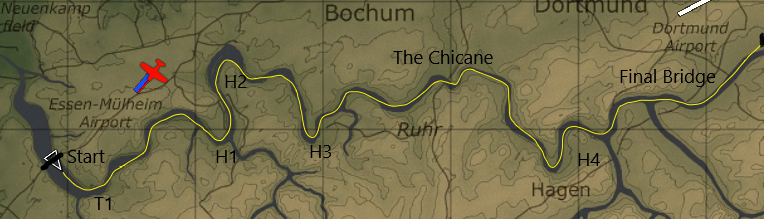
This track is chosen as it is the most popular air race track in the pilotage community and features a number of special track components that makes this sport interesting. The timer starts the moment the aircraft passes over the bridge south of the Essen-Mulheim airport. It's important that the aircraft enters the race at or near its maximum sea level airspeed as this is the longest and straightest part of the race. Passing through turn one (T1) the pilot heads through a series of very mild turns before hitting the first major speed bleed of the race. H1 or hairpin 1. A hairpin in track terminology is a sharp 180 degree turn in the track. There are several ways to traverse a hairpin and I'll touch on that later. Immediately after H1 is a long stretch followed by "the great equalizer" H2. By H2 most aircraft have lost a significant amount of their airspeed and the race evens up. The next big turn is H3 and by this turn I have learned just about everything there is to know about a given aircraft, its overheating qualities, its energy retention, its acceleration, maneuverability, things of that nature. At the half way mark between H3 and H4 is "The Chicane" which isn't important because of its shape but rather its the most common place where an aircraft will start its overheating cycle, I'll touch on that later. After “The Chicane” is H4 and the race is fairly straight after this turn. The last milestone a pilot will reach is "Final Bridge" or just "Bridge" and this marks the moment when the pilot can ignore all overheating problems and absolutely gun it to the finish line. The finish line does NOT follow the river all the way out to the "Return to the battlefield" map flip, instead the pilot flies in a straight line over the trees into the map border. This is done to ensure that the finish line is the same across all tests.
A large portion of this study is dedicated to the relationship between MEC and AEC, but what are these things? MEC or Manual Engine Control allows for precise adjustments in engine parameters, allowing the pilot to shave drag off the aircraft without disrupting any cooling ability. It often times leads to a given aircraft shaving whole seconds to as much as thirty seconds of time compared to an AEC run. AEC or Automatic Engine Control is the default engine control method. The game uses an algorithm to calculate the best times to open cowl flaps or reduce other metrics in order to cool the engine while the pilot is on WEP. However not all algorithms are the same and many of them choose to either have the worst possible set up for cooling or the worst possible set up for drag with very few cases that are somewhere in between. Here is a short list of just some of the things I'm controlling in this test when I'm using MEC: prop pitch %, oil radiator %, water radiator %, cowl flaps %, and fuel/air mixture. There are more things to MEC but these are the only ones that are important for flying fast at sea level. Most aircraft feature a variable pitch propeller, a system that allows the pilot to control the thrust on the fly. Prop pitch % is most often shortened to pp% and is typically the first number listed when I'm talking about MEC parameters.
EX: "x aircraft performed best on 90% 10% but I needed to raise rads to 50% later in the race." In my control set up the oil, water, and cowl flaps are bound to the same two buttons. This isn't a huge deal as opening or reducing oil cooling % doesn't add a ton of drag to the airframe. Rather all the drag comes from opening or closing the cowl flaps and associated ducts. Radiator % is the catch all term I use to talk about this group and I further shorten it to rads%, it's the second number when I talk about MEC parameters.
EX: "x aircraft performed best on 90% 10% but I needed to raise rads to 50% later in the race." Rads% changes the most throughout a race, often starting at a low number and after a major overheat occurs I will raise the amount in order to keep the engine cooler for longer, at the expense of drag.
During an AEC race the engine will likely overheat to some degree and when that happens the pilot is required to reduce throttle to a safe level, wait for the engine to cool off before resuming. To be more direct; when the engine temperature number is flashing red that means the engine is in danger of taking damage and the pilot needs to reduce throttle/open up the cooling system. The pilot then waits until the engine has cooled to yellow numbers before resuming at that high throttle setting. This ensures that the pilot can get all the way to the end of the race without crashing due to engine problems. In my articles I refer to this as an "over heating cycle." Not all cycles are the same however, some aircraft may never be able to go back to full WEP again, and some aircraft may never go back to 100% throttle.
With MEC the over heating cycle isn't as big of an issue as the pilot is in full control of what the engine can and can't do. Using MEC the pilot may choose to sit in solid orange or red numbers, so long as the engine isn't in danger of taking damage it's allowed. Furthermore because of the MEC tools kit the pilot may be able to stay in WEP far far longer than what the AEC test had. All MEC set ups look different between aircraft, and even some tests may have a different set up compared to each other. All of this is talked about when I write aircraft articles.
Lastly there's one more trick that a pilot can use; timing their overheating cycle. Both MEC and AEC can make use of this. For example in the CW-21 article that aircraft can get exponentially more time in WEP if I spend more time off of WEP. Which sounds counter intuitive, but after the first over heat should the pilot just wait a few extra seconds off of WEP they can get several times more seconds in WEP (once they throttle up again) before the next overheat. There's also the opposite of this trick called "WEP-flicking" where the pilot doesn't wait until the engine has fully cooled but rather has only waited enough time to no longer be in danger of a melt down before going back to WEP. Thus ensuring more time spent at max power. WEP-flicking is only useful for aircraft that have a ridiculously short overheat period, such as the MB 151, which is the plane I first discovered this with.
What is a "Plan A" and "Plan B" racer? Most aircraft are capable of retaining a majority of their energy when going through a corner. Plan A aircraft make the best use of this principle and are capable of taking the ideal race line through any given corner. Or in other words they are the most predictable aircraft to race with. Plan B racers are a lot more unpredictable and more difficult to race with. These aircraft primarily struggle with energy retention, blowing any speed they had in hairpins and even minor course corrections can be detrimental. So these aircraft can not make use of the ideal race line and instead have to take all corners as slow and methodical as possible. This means that in order to maintain their energy level they have to fly a longer course than the Plan A aircraft. A good example of a Plan B aircraft would be the CW-21 or XF5U as both aircraft bleed a ton of speed in only one full turn.